Welcome To Our Official Website, And We Will Provide You With Excellent Service.
Knitted vs. Woven Fabrics: Ultimate Tips Every Designer Must Know

When it comes to fabric production, understanding the difference between knitted and woven fabrics is essential for every textile or fashion professional. Although both belong to the world of fabric manufacturing, their weaving processes, elasticity, and application fields are completely different.
If you’re working with a custom knitwear manufacturer in China or exploring textile sourcing, this guide will help you master the fundamentals.
🌼 1. Weaving Process: Loops vs. Interlaced Yarns
Knitted Fabric
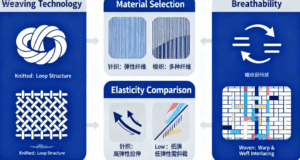
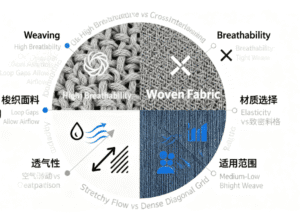
Knitted fabric is formed by interlocking yarn loops — imagine knitting a sweater by hand. The yarn is continuously looped together, creating a flexible “loop-within-loop” structure.
✨ Craft Feature: Each yarn forms circular loops, giving the fabric natural elasticity and softness. This makes knitted fabrics ideal for comfortable, body-fitting garments.
Woven Fabric (🧶)
Woven fabric is made by interlacing warp and weft yarns in a perpendicular pattern. Unlike knitting, the yarns are arranged linearly and “locked” together.
✨ Craft Feature: The warp and weft form a stable grid, resulting in firm, crisp fabrics that hold their shape well — perfect for shirts, trousers, and suiting.
🧶 2. Material Selection: Elastic Players vs. All-Rounders
Knitted Fabrics:
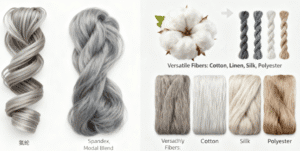
Knitted materials are often made from elastic fibers such as spandex, viscose, or cotton blends. Their elasticity and softness provide superior comfort and stretch, making them ideal for sweaters, T-shirts, and sportswear.
Woven Fabrics:
Woven textiles are true “fiber collectors.” They can be made from almost any fiber — cotton, linen, silk, polyester, wool, or specialty blends — giving them versatility across a wide range of applications, from luxury fashion to industrial use.
👗 3. Elasticity: Flexibility vs. Structure
Knitted:
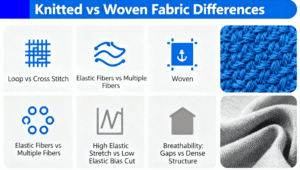
Knitted fabrics have excellent elasticity due to their looped construction. They naturally stretch and recover, fitting the body’s curves effortlessly. In fact, Coco Chanel famously revolutionized fashion by using knitted fabrics in women’s suits — blending elegance with comfort.
Woven:
Woven fabrics, on the other hand, are less elastic and require advanced tailoring techniques such as bias cutting (a diagonal cut developed by designer Madeleine Vionnet) to achieve flexibility. This method consumes more fabric but delivers impeccable drape and fit — often used for high-end custom garments.
🎈 4. Breathability: Airy vs. Dense
Knitted:
The loop structure of knitted fabrics allows excellent air circulation, making them breathable and ideal for everyday wear. This is why knitted garments are common in activewear, loungewear, and casual clothing.
Woven:
Due to the tight interlacing of warp and weft, woven fabrics are less breathable but offer great wind resistance and structure — perfect for formal wear and outerwear.

💡 Final Thoughts
Both knitted and woven fabrics play essential roles in the fashion and textile industries.
Knitted fabrics emphasize comfort, elasticity, and casual appeal.
Woven fabrics highlight structure, durability, and formality.
When working with a knitting factory in China or selecting materials for your next collection, understanding these differences helps you design better products that align with your brand vision.
At Dongguan Chuangdian Garment Factory, we specialize in both OEM knitwear manufacturing and woven apparel production — offering professional design, development, and custom sweater services for global brands.
Whether you need cozy knitwear or sharp woven tailoring, we bring your creative concepts to life with precision and quality.
How useful was this post?
Click on a star to rate it!
Average rating 0 / 5. Vote count: 0
No votes so far! Be the first to rate this post.
-35-2-768x432.png)