Welcome To Our Official Website, And We Will Provide You With Excellent Service.
Yarn Counts & Plies: The Hidden Math of Luxury

In my 20 years, I’ve seen many designers get confused by numbers. They think a “higher number” always means a “thicker fabric.” In the world of yarn counts, it’s actually the opposite.
At CdGarment, we believe that Precision is the language of the professional.
1. Understanding “The Count” (S)
In the textile industry, we use a system called the English Cotton Count (represented as ‘s’). It measures the fineness of the yarn.
Low Counts (10s – 20s): The yarn is thick and heavy. This is used for rugged sweatshirts, heavy canvas, and “boxy” streetwear tees.
Mid Counts (30s – 40s): The industry standard for high-quality retail t-shirts. It offers a perfect balance of softness and durability.
High Counts (50s – 100s+): The yarn is incredibly thin and fine. This is used for luxury dress shirts and ultra-lightweight summer knits.
The Rule: The higher the number, the thinner and finer the yarn.
2. The Power of “The Ply”
“Ply” refers to how many strands of yarn are twisted together to make a single thread.
Single-Ply (1-ply): One strand of yarn. Most t-shirts are made from single-ply yarn for a lightweight, breathable feel.
Two-Ply (2-ply): Two strands of yarn twisted around each other. This makes the thread much stronger, smoother, and more resistant to pilling.
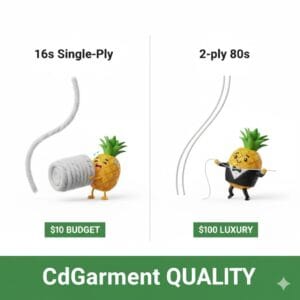
When you see a luxury shirt labeled “2-ply 80s,” it means two very fine strands (80s) have been twisted together to create a fabric that is both incredibly soft and remarkably durable.
3. Why This Matters for Your Brand
If you ask a factory for “heavy fabric,” they might give you a low-count, single-ply yarn that feels rough. But at CdGarment, we might suggest a high-count, multi-ply yarn instead. This gives you the weight you want with the luxury hand-feel your customers expect.
Simple Insight
Don’t just ask for “thick” or “thin.” Speak in counts and plies.
At CdGarment, we help you calculate the exact yarn math needed to achieve the specific drape and longevity your design requires.
-768x392.png)
-9-768x387.png)