Welcome To Our Official Website, And We Will Provide You With Excellent Service.
How to choose the right yarn for weaving?

In the process of weaving sweaters, garments, or other fabrics, yarn is the core element that determines the quality, hand feel, and appearance of the finished product. Choosing the right yarn not only ensures that the fabric meets design expectations but also reduces production losses and improves customer satisfaction. Especially when cooperating with big brands, yarn standards directly affect the pass rate of cooperation. From a practical perspective, this article breaks down the key logic of selecting suitable yarn, catering to both beginners and advanced industry needs.
I. Clarify Core Needs: Deduce Yarn Direction from “Purpose”
The first step in choosing yarn is to accurately locate the usage scenario and core requirements of the fabric to avoid blind trial and error:
1. Determine the product type: – Close-fitting clothing (underwear, thin sweaters): Prioritize soft, breathable, and skin-friendly yarns (such as combed cotton, modal, and cashmere blends); – Outerwear/workwear (thick sweaters, outer fabric): Focus on wear-resistant, anti-pilling, and stiff yarns (such as carded cotton, acrylic blends, and wool); – Functional clothing (sportswear, outdoor sweaters): Need to have moisture-wicking, quick-drying, and elastic properties (such as polyester elastic yarn, bamboo fiber blends).
2. Clarify quality standards: – Cooperating with big brands: Must meet OEKO-TEX Standard 100 environmental certification, color fastness ≥ grade 3-4, anti-pilling ≥ grade 3, and other indicators; – Ordinary orders: Can balance hand feel and durability according to customer budget (for example, using cotton-acrylic blends instead of pure wool to reduce costs).
3. Lock in design details: – Texture effect: Plain weave and twill weave require yarns with uniform evenness; jacquard and cable-knit sweaters can use thick yarns with a certain degree of bulkiness; – Color requirements: Dark-colored fabrics need yarns with high color fastness (such as combed dyed yarns), and light-colored fabrics need to pay attention to the whiteness and purity of the yarns.
II. Analyze Core Yarn Parameters: Quick Screening from 3 Dimensions
Yarn parameters directly determine fabric performance. There’s no need to memorize them by rote; focus on the following 3 points:
1. Raw Material: Determines the “Foundation” of the Fabric
Material Type | Core Advantages | Applicable Scenarios | Matters Needing Attention |
|---|---|---|---|
Natural Fibers (cotton/wool/silk/flax) | Skin-friendly, breathable, and good texture | Mid-to-high-end sweaters, close-fitting clothing | Cotton wrinkles easily, wool pills easily, and flax is relatively hard |
Chemical Fibers (polyester/acrylic/viscose) | Wear-resistant, easy to care for, and low cost | Workwear, affordable clothing, functional fabrics | Pure polyester has poor breathability and needs blending to improve |
Blended Fibers (cotton-polyester/wool-acrylic) | Combines multiple advantages (e.g., cotton-polyester is wear-resistant and breathable) | Most daily clothing, sweaters | Pay attention to the blending ratio (e.g., 60% cotton + 40% polyester has the highest cost performance) |
2. Yarn Specifications: Affect Fabric “Density and Hand Feel”
– Fineness (count): The higher the number, the finer and softer the yarn (e.g., 40S cotton is suitable for thin sweaters, 16S cotton is suitable for thick outerwear); – Twist: High twist → yarn is tight and wear-resistant but feels hard; low twist → yarn is bulky and soft but easy to deform (medium-low twist is commonly used for sweaters); – Plies: Single-ply yarn (lightweight, breathable), double-ply yarn (thick, durable), multi-ply yarn (stiff, textured). Double-ply yarn is mostly used for sweaters to balance hand feel and strength.

3. Process Characteristics: Adapt to Production and Usage Scenarios
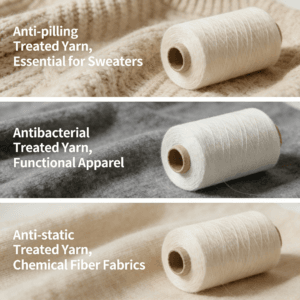
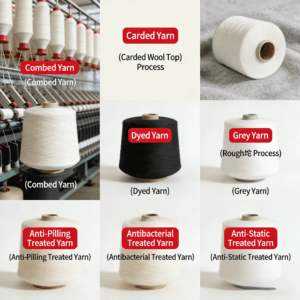
Spinning process: Combed yarn (low impurity, uniform evenness, suitable for high-end clothing) vs. carded yarn (low cost, bulky, suitable for casual sweaters); – Dyeing and finishing process: Dyed yarn (uniform color, high color fastness, reducing dyeing loss) vs. grey yarn (needs subsequent dyeing, high flexibility but long cycle); – Special treatment: Anti-pilling treatment (essential for sweaters), anti-bacterial treatment (functional clothing), anti-static treatment (chemical fiber fabrics).
III. Combine Production Reality: Avoid “Choosing the Right Yarn but Facing Production Difficulties”
1. Match weaving equipment: – Knitting machines (commonly used for sweaters): Need to choose yarns with moderate elasticity and uniform evenness to avoid yarn breakage due to excessive thickness or brittleness; – Looms (outer fabric): Can use yarns with high strength and stable twist to adapt to high-density weaving needs.
2. Control cost budget: – High-end orders: Pure wool, cashmere, and combed long-staple cotton to improve texture; – Cost-effective orders: Cotton-acrylic blends, polyester-viscose blends instead of pure materials to reduce costs while ensuring basic performance; – Pay attention to loss rate: Thick yarns and low-twist yarns have a higher loss rate, so it is necessary to reserve a margin in advance (usually 5%-10% more than the actual dosage).
3. Meet customer requirements: – Provide yarn samples: Let customers confirm the hand feel, color, and texture to avoid rework after mass production; – Clarify testing standards: Communicate in advance the yarn’s environmental certification, color fastness, anti-pilling, and other indicators. Especially for big brand orders, test reports need to be provided.

IV. Pitfall Avoidance Guide: 4 Common Mistakes for Beginners
1. Only focusing on material and ignoring specifications: For example, the same cotton, 40S combed yarn and 16S carded yarn have completely different hand feels and uses, so the yarn should be selected according to the thickness of the product; 2. Neglecting the blending ratio: For example, wool blended with acrylic, too high acrylic ratio will make the hand feel hard, and too low will result in poor anti-pilling effect (it is recommended that wool 60%-70% + acrylic 30%-40%); 3. Ignoring yarn stability: Before mass production, test the breaking strength and twist uniformity of the yarn to avoid frequent yarn breakage or fabric deformation during production; 4. Overpursuing “high-end materials”: For example, using pure wool for close-fitting sweaters without shrink-proof treatment, leading to shrinkage after customers wear them, which affects reputation instead.
V. Practical Steps Summary: Quick Yarn Selection in 3 Minutes
1. Define needs: Clarify the product type (sweater/outerwear), usage scenario (close-fitting/outdoor), and quality standard (high-end/affordable); 2. Screen materials: Choose natural fibers, chemical fibers, or blended fibers according to needs; 3. Select specifications: Determine the count, plies, and twist to match the fabric thickness and hand feel; 4. Check processes: Choose spinning and dyeing processes according to production equipment and dyeing needs; 5. Conduct tests: Weave small batches, test the fabric’s hand feel, strength, anti-pilling, and other indicators, and purchase in bulk after confirmation.
Choosing the right yarn is essentially a process of “balancing needs, quality, cost, and production”. Whether it is pattern-based sample making, sample replication, or independent design, aligning the core parameters of the yarn with actual needs in advance can not only make the finished product meet expectations but also improve production efficiency and reduce cooperation risks. If you need to recommend yarn for specific products (such as a certain sweater or outer fabric), you can provide detailed needs for more accurate matching!
-35-2-768x432.png)