Welcome To Our Official Website, And We Will Provide You With Excellent Service.

What Is Cashmere? A Guide to Quality, Care & Facts

Cashmere is often called the “gold of fibers” for its softness, lightweight warmth, and luxury. But many people don’t know the basics: where it comes from, how to spot quality, or how to make it last. This guide covers all essential cashmere facts to help you shop smarter and care for your pieces.
What Is Cashmere? (Not Sheep Wool!)
A common myth: Cashmere comes from sheep. It actually comes from the downy undercoat of cashmere goats (Capra aegagrus hircus), native to Central Asia’s mountainous regions (Mongolia, China, India, Afghanistan). These goats grow a coarse outer guard hair for protection, with a soft undercoat that keeps them warm in -40°C weather.
Unlike sheep’s wool (sheared), cashmere is collected during spring molting—by hand-combing or gentle plucking (no harm to goats). Each goat only produces 50–200 grams of pure cashmere per year. It takes 4–6 goats to make one sweater, and 40 for a coat—why genuine cashmere is pricey.
Note: Pashmina is a type of cashmere from India’s Kashmir region (extra-fine fibers). All pashmina is cashmere, but not all cashmere is pashmina.
Cashmere Quality: How to Grade It
-2-scaled.png)
Not all cashmere is the same. Quality depends on three key factors: fiber diameter (microns), length, and purity (guard hair content). Most brands use a Grade A/B/C scale, with Grade A being the finest.
1. Fiber Diameter (Microns)
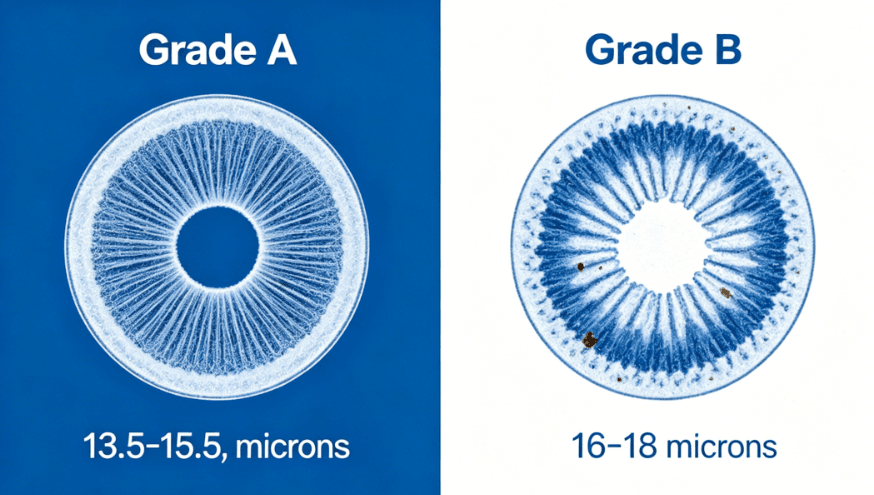
Microns measure fiber thickness—the smaller the number, the softer the cashmere. A human hair is ~75 microns; high-quality cashmere is 14–15.5 microns. Here’s the breakdown:
- Grade A: 14–15.5 microns (finest/softest). Minimal pilling, lasts 10+ years with care. Reputable Grade A sweaters cost $300–$800.
- Grade B: 16–17 microns (good softness/durability). More affordable ($150–$350). May pill slightly at first, but stabilizes after one season.
-768x392.png)

-9-768x387.png)